FilterPageBuilder.GetView, Language Bugs, and Adding Spare Brained Licensing
Two things on the agenda for this stream: fixing a subtle language-related bug in how I use FilterPageBuilder.GetView, and starting to integrate Spare Brained Licensing
into my Automatic Write-Offs app. The full stream is on YouTube
if you want the unfiltered version.
The GetView Language Bug
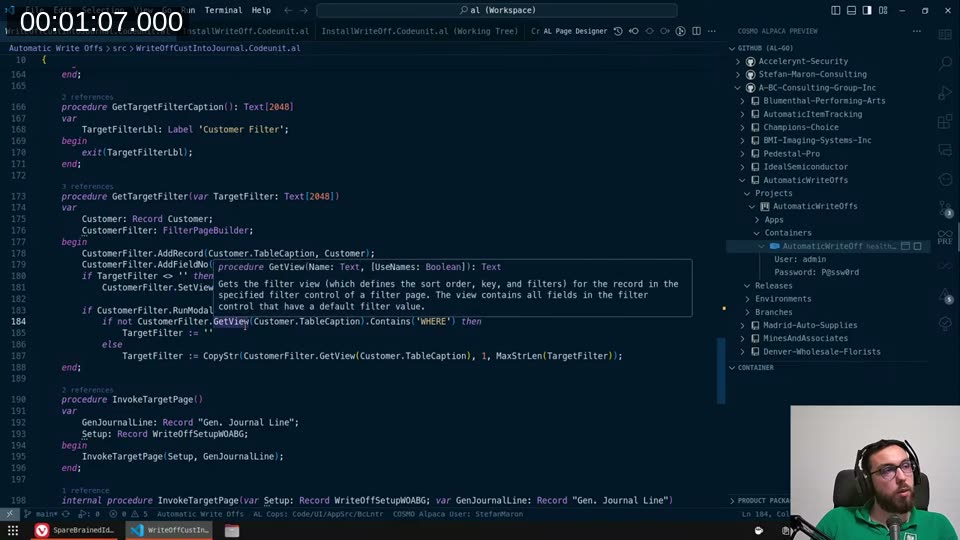
Someone pointed out in a comment on a previous video that the filter views I store in the database can break if a user switches language. I hadn’t noticed it myself, but once I started digging it was obvious.
The FilterPageBuilder.GetView method has an optional second parameter called UseNames. Its default value is true, which means the returned filter string contains field captions rather than field numbers. That’s fine for display, but the moment you persist that string — into a setup table, a database record, anywhere — and then a user opens it with a different language installed, the filter no longer applies correctly. The caption-based filter string is language-specific, and BC can’t resolve it when captions differ.
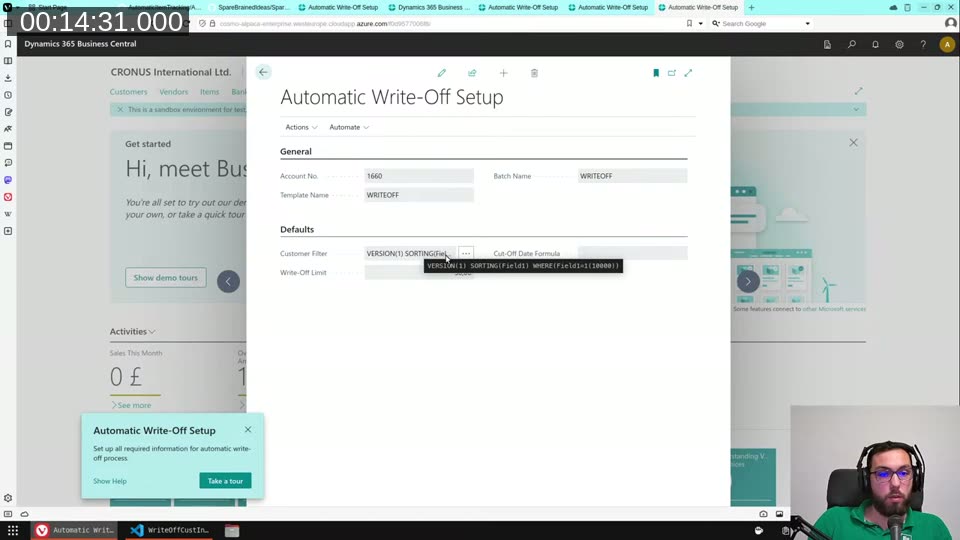
On stream I verified this by installing the German language pack and switching my test environment to German. With UseNames = true (the default), the saved filter simply disappeared — BC couldn’t load it. With UseNames = false the filter string uses field numbers (VERSION(1) SORTING(Field1) WHERE(Field1=1(10000)) and similar), which are language-neutral and load fine in every language.
The fix is a one-liner in every place you call GetView on a FilterPageBuilder:
TargetFilter := CopyStr(CustomerFilter.GetView(Customer.TableCaption, false), 1, MaxStrLen(TargetFilter));
📖 Docs:
FilterPageBuilder.GetView(Text [, Boolean])— ifUseNamesistrue(the default), the returned string contains field captions. Set it tofalseto get field numbers instead, which is what you want whenever you store a filter string.
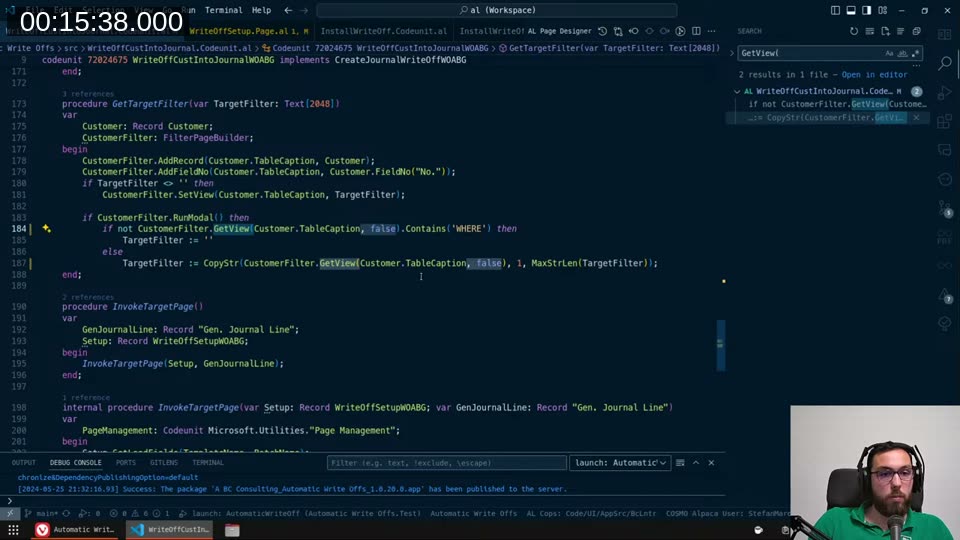
In my extension there were only two call sites. In a larger codebase you’d want to search for every GetView on a FilterPageBuilder and check each one. Toward the end of the stream I mentioned this could be a good LinterCop rule — a diagnostic that warns whenever GetView is called without explicitly setting UseNames to false. Something to look at in a future stream.
Integrating Spare Brained Licensing
The Automatic Write-Offs app is heading to AppSource as a paid extension, so it needs licensing enforcement. I’ve used Spare Brained Licensing by Jeremy Vyska before and it’s the right tool for this. It’s open source, free, available on AppSource, and supports both Gumroad and Lemon Squeezy out of the box — those platforms handle all the VAT, payment processing, and affiliate logic, so you just receive money.
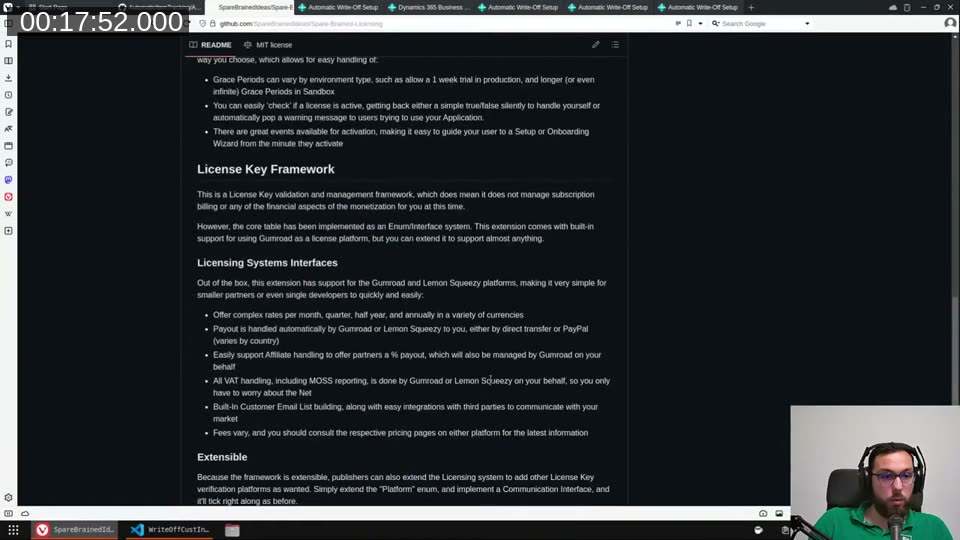
Jeremy recently merged the separate PTE and AppSource versions of the library into a single build, which makes things simpler. Since Microsoft opened the AppSource object ID range for development with the CRONUS license, there’s no longer a reason to maintain two numbering schemes.
The first step was cloning the Spare-Brained-Licensing repo, fixing a backslash/forward slash issue in the VS Code settings (Jeremy uses backslashes — forward slashes work everywhere, including Windows), publishing the extension to my BC container, and then adding a dependency in my Automatic Write-Offs app.json.
Next came writing the install codeunit logic. In HandleFreshInstall I call ExtensionsRegistration.RegisterExtension with the app info, product code, support URL, billing email, grace period days, minimum licensing version, and the license platform enum set to LemonSqueezy:
ExtensionsRegistration.RegisterExtension(
    AppInfo,
    'test',
    'someUrl.com',
    'someUrl.com',
    'billing@email.com',
    '',
    14,
    14,
    Version.Create(1, 0, 0, 0),
    Enum::"SPBLIC License Platform"::LemonSqueezy,
    true
);
The actual product code and API keys will be filled in off-stream once I’ve wired up the Lemon Squeezy side. The structure is in place.
Gating the Generate Action
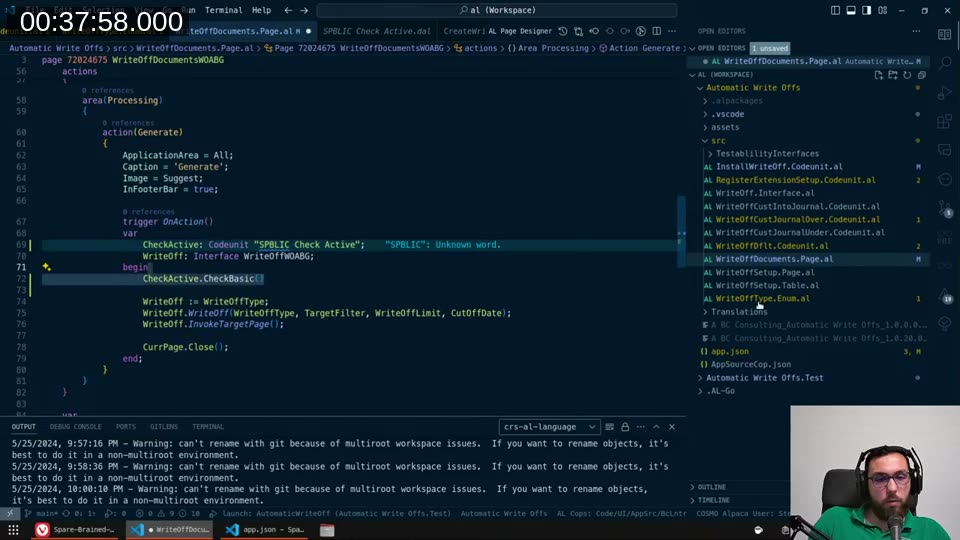
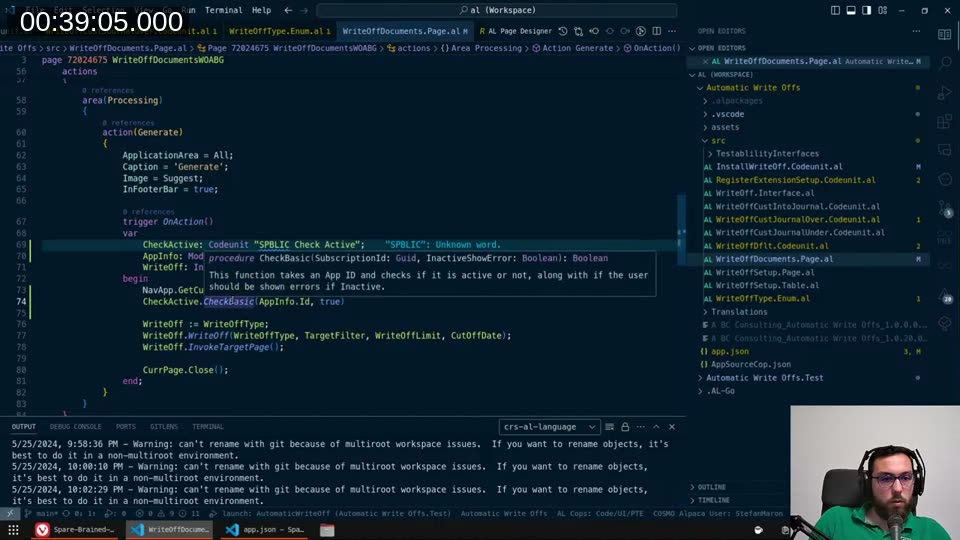
With registration done, I also need to prevent the app from working without a valid license. I created a small CheckActive codeunit wrapper that calls CheckBasic(AppInfo.Id, true) — the true flag means BC will surface an error to the user if the license is inactive rather than silently returning false.
I call this at the top of the Generate action trigger on the Write-Off Documents page, and also at the top of each WriteOff implementation codeunit:
trigger OnAction()
var
    CheckActive: Codeunit "SPBLIC Check Active";
    AppInfo: ModuleInfo;
    WriteOff: Interface WriteOffWOABG;
begin
    NavApp.GetCurrentModuleInfo(AppInfo);
    CheckActive.CheckBasic(AppInfo.Id, true);

    WriteOff := WriteOffType;
    WriteOff.WriteOff(WriteOffType, TargetFilter, WriteOffLimit, CutOffDate);
    WriteOff.InvokeTargetPage();
    CurrPage.Close();
end;
A Bug I Found in the Library
While testing I tried forcing the grace period to zero days to verify the license check actually blocks the app. It didn’t block it — the app was still usable on the day of install even with daysAllowedBeforeActivation = 0. Looking at the RegisterExtension source in the library, the grace end date is calculated as:
if GraceDays > 0 then
    GraceEndDate := CalcDate(StrSubstNo(PlusDaysTok, daysAllowedBeforeActivationProd), Today)
else
    GraceEndDate := Today;
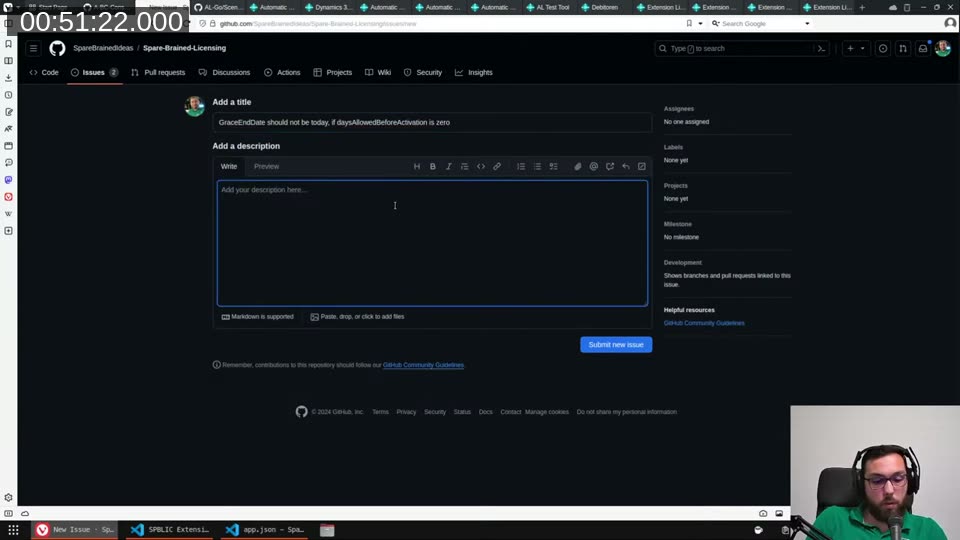
When GraceDays = 0, GraceEndDate gets set to today, which means the app is still licensed today. If you want zero grace — no trial at all — you’d expect GraceEndDate to be yesterday (or at least a date before today). I filed an issue against the Spare-Brained-Licensing repo for this. It might be intentional behaviour, but it surprised me.
AL-Go Dependency Wiring
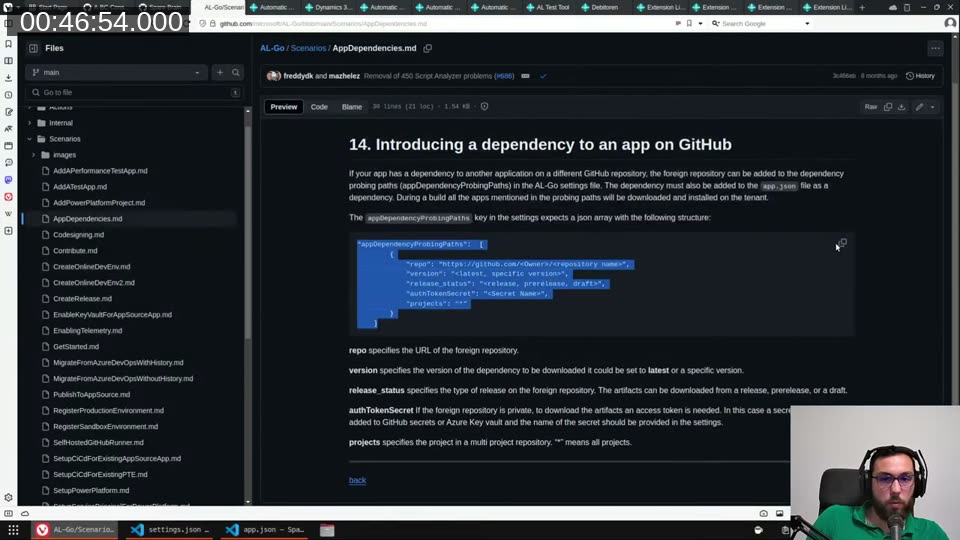
The final piece is telling AL-Go to pull the Spare-Brained-Licensing app automatically during CI builds. That goes in the appDependencyProbingPaths setting in AL-Go-Settings.json:
"appDependencyProbingPaths": [
  {
    "repo": "https://github.com/SpareBrainedIdeas/Spare-Brained-Licensing",
    "version": "latest",
    "release_status": "release",
    "projects": "*"
  }
]
📖 Docs: AL-Go — Introducing a dependency to an app on GitHub —
release_statusacceptsrelease,prerelease, ordraft. AL-Go can only pick up artifacts from AL-Go-built releases; a manually created GitHub release won’t work here.
The catch: for this to actually work in the pipeline, the Spare-Brained-Licensing repo needs a release that was created by AL-Go itself, not a manual one. I need to ask Jeremy to create one. Until then the local dev setup works fine, but the CI build won’t be able to resolve the dependency automatically.
This post was drafted by Claude Code from the stream transcript and video frames. The full stream is on YouTube if you want the unfiltered version. (I did read and check the output before posting, obviously 😄)